



Nut
Haodeli: Leading Nut Manufacturer in China!
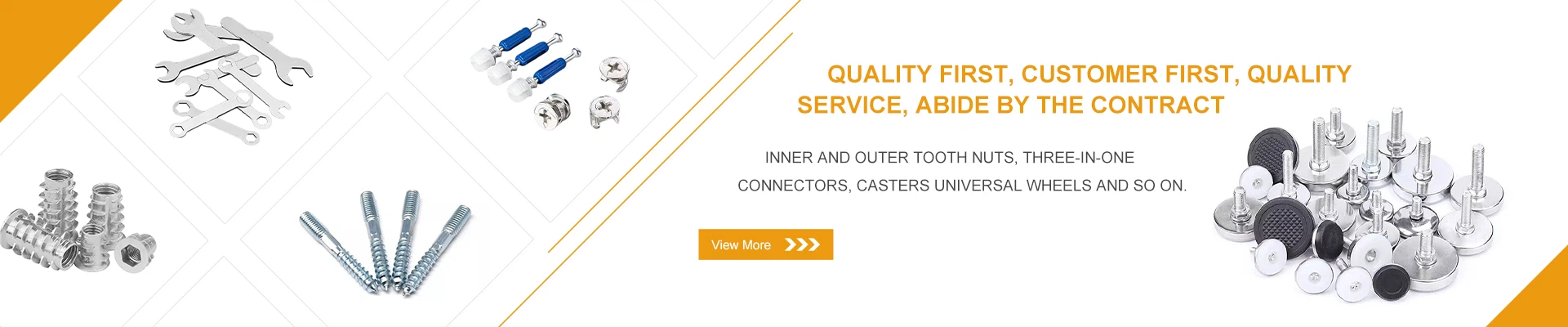
Shenzhen Haodeli Furniture Fittings Co., Ltd. (referred to as "Haodeli Hardware Fittings Factory") is a manufacturer specializing in the production and sales of furniture hardware accessories and furniture plastic accessories manufacturers. The main products are: inner and outer tooth nuts, three-in-one connectors, casters universal wheels and so on.
Wide Product Range
We can export various custom fasteners with a wide variety of plating, which includes different colors of Zinc, Black Oxide, Black Anodizing, Tin, Silver, Waxing, Passivation, Nickel, Antique Brass, Chrome, Cadmium, GM Spec, Magni Coating, Chrysler spec, and so on.
Quality Raw Materials
We supply both inch and metric fasteners. Our fastener line includes a wide range of materials such as steel, stainless steel, brass, silicon bronze, Hastelloy, Inconel, Monel, aluminum, alloy 20, 17-4PH, 17-7PH, titanium, and other non-ferrous metals.
Quality Guaranteed
From quality testing of raw materials to the careful management of manufacturing processes and the comprehensive testing of finished products, we can deliver customer orders that live up to and exceed expectations.
Advanced Equipment
With state-of-the-art Japanese technology power coating lines and professional fabrication machines such as automatic welding and tube laser cutting machines, customers can be assured that every product will be fabricated with precision and care.


Introduction of Nut
Nuts are female fasteners with a threaded hole and are used to secure a stud or bolt. They are generally hex-shaped and are loosened and tightened with a wrench, while others are knurled. The knurled variety does not require tools to make adjustments. We stock a variety of machine screw hex nuts, potentiometer and control hex nuts, hex flange nuts, heavy hex nuts, and thumb nuts.
Custom Nuts Specifications
Materials (Metals)
Alloy Steels
Aluminum
Beryllium
Brass
Silicone Bronze
Carbon Steel
Magnesium
Molybdenum
Monel
Inconel
Nickel
Stainless Steel
Tin
Titanium
Hardening Specification
We can manufacture many custom fasteners to your specification:
Dowels & Pins
Hose Couplings
Nails
Rivets
Screws
Shackles
Shaft Couplings
Studs
Materials (Plastic Polymers)
Various Plastics
Nylon
Standard
British
English
Metric
Bolt Types
We can manufacture many custom bolts to your specification:
Anchor
Bent
Eye
Hook
J
U
Carriage
Countersunk
Elevator
Lag
T-Handle
T-Slot
Flange
Carriage
Bent
Plow
Bolt & Screw Head Types
We can manufacture many custom head types to your specification:
Binding
Button
Fillister
Flat
Flat Undercut
Headless
Hexagon
Indented Hexagon
One-Way
Oval
Pan
Pentagon
Phillips
Round
Shoulder
Square Shoulder
Socket
Trimmed Hex
Truss
12-Point
Thread Types
We can manufacture many custom thread types to your specification:
ACME
Drywall
Machine
Self-Tapping
Self-Drilling Drive Screws
Self-Drilling
Type 17
Type 23
Type 25
Type A
Type AB
Type B
Type F
Wood
UNC
UNF
Bolt & Screw Drive Types
We can manufacture many custom drive types to your specification:
Combination
Hex/Hexagonal
Phillips
Six Lobe
Slotted
Socket
Square
Tamper Resistant
Torx
Nut Types
We can manufacture many custom nut types to your specification:
2-Way
Anchor
Cap
Castle
Conical
Coupling
Finished Hex
Flex Lock
Heavy Hex
Hex Flange
Hex Jam
Keps
Nylon Insert
Nylon Patch
Nylon Pellet
Semi-Finished Hex
Serrated Hex Flange
Slotted Hex
Square
Thumb
Top Lock
Wing
Finish
Automotive
Black Oxide
Brass Plated
Cadmium
Chromate
Chrome
Color Coated
Galvanized
Nickel Plated
Painted
Phosphate
Polished
PTFE
Silver Plated
Teflon
Zinc Plated
Industry Standards
ANSI - American National Standards Institute
ANSI B 18.2.4 2M
ANSI B 28.2.4 1M
DIN
DIN 934
DIN 970
ISO - International Organization for Standardization
ISO 4032
ISO 4033
UTS - Unified Thread Standard
UNC
UNF
UNEF
UNS
NPT
NPTF
Provide CAD Files Or 3D Files or Samples
Only through the above information you provided we can know the size, precision, and key features of the product to be controlled, which is the basis for us to accurately evaluate the price of the product.
Get a Quote
Tell us the quantity of products you need, and we will provide you with corresponding ladder prices according to different quantity requirements.
Specify Process, Material, Surface Treatment
If your requirements are consistent with the drawings you provide, it is not necessary to specify.
Order Your Parts
Send your order to us, we will reply to your specific delivery date.
Receiving Your Parts
After the order is completed, we will notify you in time and cooperate with you in logistics operations.

Nuts are incredibly simple to use. All you need is a wrench or socket set to attach them to the desired material. Once they’re secured, they provide a strong connection that can withstand high levels of tension without breaking or coming loose. Another advantage is that their small size makes them ideal for tight spaces where larger fastening tools may not fit. Additionally, they can be used with a variety of materials, including metal, plastic, wood, and more.
● Nuts are strong and durable.
● Nuts are easy to install.
● Nuts are corrosion-resistant.
● Nuts are reusable.
● Nuts are widely available.
What are the Different Types of Nuts?
The vast majority of nuts, no matter what type, are hex shaped. This is because the six sides make it easy to turn. It only takes a one-sixth turn for the nut to reach the next flat parallel. A nut with fewer sides takes more time to install. Other shapes are available, which are for specific needs.
Dome
Protects bolt threads underneath while presenting a clean appearance. Also can prevent skin and clothes from snagging on sharp edges.
Acorn
A type of cap nut with the same capabilities. Named after its head, which is shaped like an acorn. Cap nuts are used across all industries and also resist vibration.
Wing
The side wings enable quick, easy tightening and removal by hand. For this reason, it should not be used if vibration is present.
Jam
Low-profile nuts that, when jammed into place against a standard nut, prevents loosening. Also used when a standard nut won’t fit.
Flange
The flange serves the purpose of a washer, evenly distributing the load. Typically used in the automotive sector on exhausts.
Coupling
While not typically a bolt nut, these are used for connecting threaded rods or pipes together.
Nyloc
Insert creates friction, resulting in a gripping action and reducing chance of loosening due to vibration. Commonly used in white goods, computers and vehicles.
Square
A type of blind nut, its shape means that more of its surface is in contact with the material being, which reduces the chances of it loosening. Typically used with square-headed bolts.
Hex
Different types of hex nuts all provide a reliable hold. Easy to tighten and loosen due to its shape. Used in applications across all industries, from automotive to machinery.
Tee
For fastening soft materials such as wood or plastic. The flange on one side has hooks, which latch onto the material being fastened to strengthen the joint and leave a flush surface.
Slotted
Secured using a cotter pin or wire to prevent rotation. Typically used in applications where vibration is a constant threat.
Castle
The turret geometry on the castle nut differentiates this from the slotted nut. Their functions and how they work are the same
Keps-K Lock Nuts
Designed for easy assembly. The attached free-spinning serrated washer creates tension against the material’s surface when installed onto a bolt. Note: overtightening will cause the nut to fail.
Prevailing Torque Nut
The distortion of the top threads creates locking action, which causes the nut to resist loosening due to shock and vibration. They are installed with the conical top up, which makes these one-way lock nuts.
Kwik
Plastic push-on nut is applied to a threaded bolt and tightened manually or with a spanner or other tool. It can only be loosened with a wrench. Used when quick assembly is a priority.
Nuts are commonly made of metal, but other options are available.
Aluminum nuts are light, resistant to oxidation, thermal and electrical conducive, and easy to manufacture.
Brass nuts are strong, conductive, corrosion resistant, with low magnetic permeability.
Copper alloy nuts have good load capacity, wear resistance, and are suitable for dynamic loads.
Fiber-reinforced plastic nuts use industrial fabric reinforced urethanes. They are wear resistant.
Inconel/Incoloy metal nuts provide good strength and oxidation/carbonization resistance in high temperatures. They can be used in temperatures up to 1200° F.
Nylon nuts are made of a tough and resistant material. It has good pressure ratings.
Plastic nuts are inexpensive and corrosion resistant for light loads.
Polytetrafluoroethylene (PTFE) is an insoluble compound and PTFE nuts have durability and low friction.
Polyvinyl chloride (PVC) is inert and resistant to chemicals, and PVC nuts are flexible, smooth, and non-toxic.
Polyvinylidene fluoride (PVDF) nuts has less creep and better strength than other fluoropolymers, but is susceptible at high temperatures.
Rubber nuts are used in specialty applications requiring vibration and noise dampening.
Steel nuts are produced of strong, carbonated iron. Uncoated steel is vulnerable to corrosion.
Hardened steel relies on hardening methods to produce a stronger, but more brittle, version of steel.
Stainless steel nuts are chemical and corrosion resistant with an appealing finish. They cannot be hardened like carbon steel.
Titanium nuts are hard and strong, light, and corrosion resistant. When alloyed with other metals, it increases strength and durability.

Steps for Fastening Nuts and Bolts
Step 1
The first thing to do is select the type and the size of the bolts, nuts, and washers that are appropriate for the example project. Determining factors include the type of material used for the example project, the type of fastening/connection that is needed, how strong the bolt needs to be to secure the connection, how many nuts, bolts, and washers are needed, or any specific manufacturer requirements that may be necessary. These are just a few of things to consider when you do an actual project. If you aren’t sure about what type or size is correct, ask a qualified representative at a home improvement center for help.
Step 2
Select a bolt and a washer. Slide the washer onto the end of the bolt and push it as far as it will go until it reaches the head of the bolt.
Step 3
Using the example project of two wood pieces, place the two pieces side by side and align the drilled holes so the bolt can be inserted between the two to make a connection.
Step 4
Take the bolt with the washer in hand and push the threaded shaft through the hole in the first piece of wood and continue pushing on through the second hole. The one piece of wood will have the washer and bolt head protruding from its hole while the threaded end of the bolt will be protruding from the hole of the second piece of wood.
Step 5
Take another washer and place it on the threaded shaft protruding from the second piece of wood. Push the washer all the way up until it is flush with the wood material.
Step 6
Place the nut on the end of the threaded shaft. Be sure the washer is aligned properly with the threads on the bolt and then begin to twist it clockwise until it reaches the washer. Tighten the nut with your fingers to secure it.
Step 7
Complete the fastening process by using a wrench that fits the size of the nut. Place the wrench on the nut and tighten it firmly so there is no wiggle room between the nut and the washer.
Common Problem of Nut