Wood Threaded Inserts

Haodeli: Leading Wood Threaded Inserts Manufacturer in China!

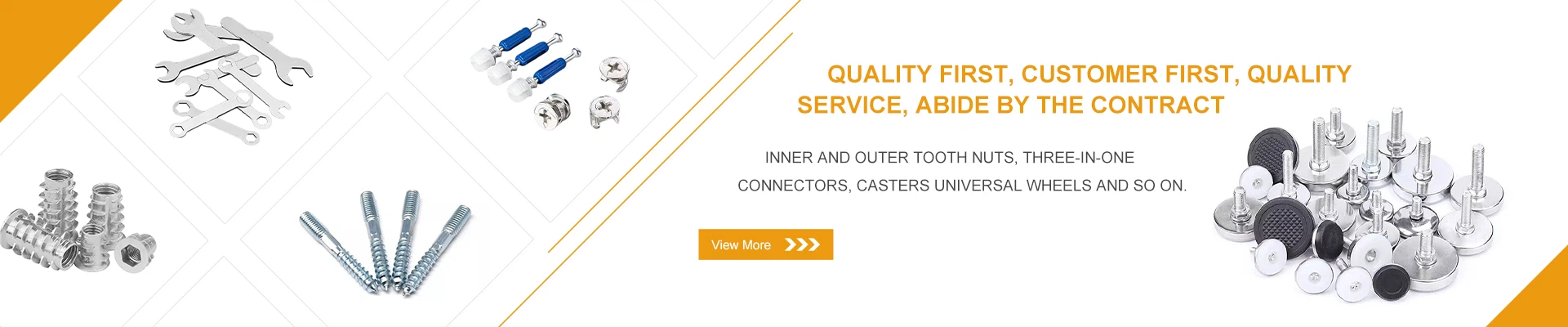
Shenzhen Haodeli Furniture Fittings Co., Ltd. (referred to as "Haodeli Hardware Fittings Factory") is a manufacturer specializing in the production and sales of furniture hardware accessories and furniture plastic accessories manufacturers. The main products are: inner and outer tooth nuts, three-in-one connectors, casters universal wheels and so on.

Wide Product Range

We can export various custom fasteners with a wide variety of plating, which includes different colors of Zinc, Black Oxide, Black Anodizing, Tin, Silver, Waxing, Passivation, Nickel, Antique Brass, Chrome, Cadmium, GM Spec, Magni Coating, Chrysler spec, and so on.

Quality Raw Materials

We supply both inch and metric fasteners. Our fastener line includes a wide range of materials such as steel, stainless steel, brass, silicon bronze, Hastelloy, Inconel, Monel, aluminum, alloy 20, 17-4PH, 17-7PH, titanium, and other non-ferrous metals.

Quality Guaranteed

From quality testing of raw materials to the careful management of manufacturing processes and the comprehensive testing of finished products, we can deliver customer orders that live up to and exceed expectations.


Advanced Equipment

With state-of-the-art Japanese technology power coating lines and professional fabrication machines such as automatic welding and tube laser cutting machines, customers can be assured that every product will be fabricated with precision and care.


First 123456 Last 1/6

Introduction of Wood Threaded Inserts


Wood Threaded Inserts are insert nuts that go into a predrilled hole in wood and has internal threads. These wood insert nuts feature threaded designs, external protrusions bite into the wood, providing superior holding power and preventing the insert nuts from either turning or pulling out in all applications.


How Do You Cooperate With Us?

Provide CAD Files Or 3D Files or Samples
Only through the above information you provided we can know the size, precision, and key features of the product to be controlled, which is the basis for us to accurately evaluate the price of the product.

Get a Quote
Tell us the quantity of products you need, and we will provide you with corresponding ladder prices according to different quantity requirements.

Specify Process, Material, Surface Treatment

If your requirements are consistent with the drawings you provide, it is not necessary to specify.

Order Your Parts

Send your order to us, we will reply to your specific delivery date.

Receiving Your Parts

After the order is completed, we will notify you in time and cooperate with you in logistics operations.


Benefits of Using Wood Threaded Inserts
 

Increased Strength
By creating a threaded metal-to-wood connection, these inserts significantly improve the strength of the joint compared to using screws directly into the wood. They reduce the risk of screws pulling out, ensuring a long-lasting and stable assembly.

Versatility
Threaded inserts can be used with various wood types, including hardwoods, softwoods, plywood, and composite materials, making them suitable for a wide range of woodworking applications.

Easy Installation
Installing threaded inserts for wood is a straightforward process. With pre-drilled pilot holes, the inserts are screwed into place, offering convenience and saving valuable time during assembly.

Reusable Connections
One of the significant advantages of threaded inserts is their reusability. Unlike screws installed directly into wood, threaded inserts allow fasteners to be removed and reinstalled without damaging the wood, making them ideal for projects that require disassembly and reassembly.

Uniformity and Precision
Threaded inserts provide consistent and precise alignment, resulting in professional-looking woodworking projects with well-aligned joints and connections.

Load Distribution
By distributing the load over a larger area within the wood, threaded inserts reduce the stress concentration on individual wood fibers, minimizing the risk of splitting or cracking.

Corrosion Resistance
Threaded inserts made from materials like brass or stainless steel are resistant to corrosion, making them suitable for indoor and outdoor woodworking applications.


What Material are Threaded Inserts for wood Made of?


Threaded inserts for wood are available in a variety of metals, the most common being: brass, steel, and zinc. The type used depends on the application and the material to be cut. Every metal has advantages.

Brass Inserts for Wood

Brass

Brass inserts are easier to manufacture, which means they are cheaper. Brass is also fairly corrosion-resistant, which expands its application possibilities.
Brass inserts are most popular for use in plastics and to a lesser extent for wood.

Furniture Screw Inserts

Steel

Steel is used for inserts because it has a high tensile strength and is also generally stronger than brass. This makes it more difficult to manufacture and subsequently more expensive. However, steel is susceptible to corrosion. Fortunately, there are also threaded inserts in stainless steel, which are slightly more expensive.
Steel is the best choice for use in hardwoods.

Captive Nuts for Wood

Zinc

Zinc-threaded inserts are used on soft and processed wood. They have a yellowish color. Zinc has a low melting point for a metal, making it ideal for injection molding with a fast and efficient manufacturing process. It is not as strong as brass or steel, which is why it is mainly used in wood. Zinc reacts with the oxygen and carbon dioxide in the atmosphere to form a protective layer that prevents corrosion.


Threaded Insert Uses


Threaded Inserts for Metal
Because metals like aluminium and steel are harder than wood, thread inserts for metal feature external as well as internal threading to make insertion and removal easier. The outer threads on the metal insert are matched to the existing threading within the hole. They are commonly used in sheet metal.

Threaded Inserts for Wood
Timber, hardwood, and plywood can be used with threaded inserts. Both press-in and thread-in inserts can be used. Adhesive is commonly added too.

Threaded Inserts for Plastic
Threaded inserts for plastics differ according to the characteristics of the material. Thermoplastic materials are heat-sensitive and as a result, inserts are applied via the application of high temperatures. Once the insert has reached a specific temperature, it is pressed onto the plastic. The latter then melts around the insert before cooling. By contrast, thermoset plastics are tougher and can be drilled like metal or wood.

Threaded Inserts for Rubber
Threaded inserts for rubber are not as common as those for wood and metal but when used they can be applied via simple insertion or by placing them into a mould. Heated rubber is then injected where it will harden into place, encasing the insert.

Threaded Inserts in Industry
Industry applications for threaded inserts include many fields where parts need to be joined together or fastened securely. Some examples include:
● Building and construction
● Carpentry and woodworking
● Manufacturing and assembly
● Electrical engineering
● Aerospace and automotive engineering
● Industrial engineering and prototyping


How to Install Threaded Inserts Into Wood Pieces
Furniture Threaded Inserts

Drill the Hole

You should drill the hole into the workpiece while ensuring the depth and diameter of the drill bit are in sync with the threaded inserts. For this, you can place parchment paper on the wooden workpiece and keep the insert on it. Subsequently, mark the edge and use a drill bit of the same size.

M8 Insert Nut

Screw Tap Bolt

Screw the tap bolt into the threaded insert to get a larger, more prominent hexagonal head. It makes driving the hardware fastener into the wood workpiece more efficient.


Wood Inserts for Bolts

Insert the Threaded Insert

Put the threaded insert into the wooden workpiece by turning the hexagonal head in a clockwise direction.

Metal Inserts for Wood

Drive the Insert Further

Once the insert is inserted halfway down the drilled hole, you should use a ratchet system to drive it inside the wooden workpiece.


Understanding T-Nuts and Threaded Inserts


Threaded inserts can come in handy for certain assembly tasks. T-nuts - a variation of threaded inserts - are another niche piece of hardware that add a helpful arrow to your woodworking quiver.
Threaded inserts and T-nuts provide a way to use bolts or other threaded hardware to attach things like legs, headboards or backsplashes to furniture quickly and easily, with the added benefit that the pieces can be taken apart - or knocked down - with very little fuss.
While it may seem as if the uses for this sort of joint would be limited, it is surprising how often they come in handy. And sometimes they are the only solution.
It may appear that inserts and T-nuts are essentially the same in function: they provide a threaded "nut" embedded into wood or some other substrate. The main differences are in how easy they are to mount and how strongly they hold.

Mounting the Hardware
First thing you need to do is drill a hole ... or maybe two. For the barrel-shaped inserts, one hole will do. They will thread into place flush to the surface of the workpiece. For T-nuts, screw-on T-nuts and tapered/flanged threaded inserts, you need to make a decision. They will sit proud of the surface without also pre-drilling a recess for their flanged portion. See the image above for clarification; the flanged insert and the standard T-nut both are sitting slightly proud of the edge of the board. If you want whatever you are screwing into or attaching to your hardware to be tight to the surface, you need to accommodate those details.
There are also considerations regarding the hole size that you bore as the primary mounting hole. Each piece of hardware will have a specified drill bit size, most often found on their packaging. I've sometimes gone with a slightly smaller-diameter hole, especially in softer woods (basswood vs. hickory as an example). It can make installation a bit harder but provides better holding performance.
For actual softwoods, the threaded insert of choice is the tapered/flanged insert. An important point to keep in mind is that you select your insert or T-nut by the thread on the inside of the hardware - be it 1/4-20 for a 1/4" bolt or 5/16-18 (5/16" bolt) or 3/8-16 (3/8") and so on. Metric sizes are no different.
Installing standard T-nuts is easy: drill the pilot hole and hammer it home. Screwed-on T-nuts are also easy. Bore the correctly-sized hole (and flange recess if you choose), tap the T-nut in place and then pre-drill and drive in the three screws. The other inserts are a bit tricker.
A common way to drive barrel-shaped inserts into a prebored hole is with a bolt properly threaded for the insert. Add a few nuts to the bolt so that just a small amount of thread is exposed. Screw the threaded insert onto the bolt and use a ratchet to turn the insert into the hole. You might notice a screwdriver slot on the top edge of the insert. But trying to drive in an insert with a screwdriver is asking for trouble. The slot is better suited for taking an insert out.
If you have a lot of inserts to drive in, consider chucking a threaded rod into your drill/driver and put a nut on it. Then put the insert on the threaded rod and get busy.

Which Insert to Use?
If you are having trouble getting your inserts to start square to the surface of your wood, use a similar setup in your drill press ... but DON'T turn the drill press on. Use your hand to turn the chuck and thread the insert home.
The tapered/flanged threaded inserts are best used in softwood, and many have a hex-drive socket built into the insert. Use an Allen wrench to drive it in.
This is the most important question for choosing one of these pieces of hardware. For me, it comes down to how strong the joint needs to be. Classic T-nuts, while quick and easy to install, do not perform well when tension is applied (when you pull on the joint). Strong in shear and under compression, as all of these inserts are, their ability to withstand tension varies considerably. A well-installed barrel-shaped insert will provide the most strength under tension. The screwed-in T-nut is second-most strong, the tapered/flanged is next and the classic T-nut is the weakest. The chart spells this out. The riveted T-nut is also quite tenacious under tension, but it is the fussiest to install. Choose your product with those constraints in mind.
Threaded inserts and T-nuts are versatile and can solve a bunch of woodworking problems. Attaching removable panels, mounting legs with hanger bolts hanging shelves, creating knock-down projects — the limit is your imagination.


Common Problem of Wood Threaded Inserts


Q: What is furniture bolt?

A: A furniture bolt is a type of fastener which consists of an external thread that wraps around an internal thread, with a cylinder in between that allows for rotation and tensioning. The external threads are usually coarse, while the internal threads are finer. They come in various sizes from M3 to M12 and can be made from stainless steel, brass, plastic or aluminum material. They have many applications beyond just furniture, such as automotive parts and medical equipment.

Q: What are stud fasteners?

A: Studs are externally threaded fasteners that typically look like and operate as threaded bars. They’re different from screws and bolts in the fact that they don’t usually have a head that requires tightening - just continuous threading that can be paired with nuts.
However, studs are versatile fasteners that come in various shapes, styles, and sizes. So while the continuous threaded studs mentioned above are probably the most well-known, there are a bunch of other types of studs you may come across, such as:
Studs that have no head, threads at only one end, and the rest is body.
Studs that have threads at both ends, and an unthreaded body in the middle.
Studs that have different threads at both ends, and an unthreaded body in the middle.
Studs that have different diameters at both ends, and an unthreaded body in the middle.
Studs that have a hex or collar in the middle.
Studs with a head at one end to be permanently attached to a tapped component via welding, swaging, or bonding.
As you can see, there are lots of options here, and that’s only really the start of them. But all of that variety and versatility is what makes studs so useful.

Q: What is type d insert nut?

A: Type D Insert Nuts for Wood, or Screw In Insert Type D, are self-tapping insert nuts that provide a strong and permanent thread for wood and wood-based sheet materials, and that are typically used for knock down furniture assemblies.
They are installed by simply screwing the self-tapping body into the base material.
The unique external thread of the Insert Nut Type D ensured positive locking and offers strong resistance against pull-out due to vibration, torsion or tensile loads. The flange head prevents the splitting of covered surfaces and driving the insert nut in too far. The internal threads enable joint connector bolts to be secured for furniture assembly.

Q: What are the benefits of hex nuts?

A: The most common shape today, when it comes to hardware nuts, is six-sided hexagonal. You’ll find hex nuts in furniture, building frames, kids’ toys, automobiles and household appliances.
Why are hex nuts popular? Well hex nuts give a good granularity of angles for a tool to approach from… and this especially helps out when a person is dealing with tight spots.
Hex nuts are easy to turn because they have six parallels. Because hex nuts have six sides, a person can turn a fastener one-sixth of the way to reach the next parallel. If a person was using a square nut, they’d have to turn it one-quarter of the way each time to reach the next parallel. It’s faster and easier to do a one-sixth turning than a one-quarter turning.
If a nut had more than six sides it could break or fracture. Six sides is ideal– any more than that and you’d have issues! No wonder, then, that the hex nut is universally accepted. They’ve become the universally accepted standard, used by consumers and businesses all over the world.

Q: What are advantages of cross barrel nut?

A: Easy to Install – Cross barrel nuts are incredibly easy to install, and you don’t need special tools to fix them. They only require a threaded stud and a washer, making it ideal for DIY enthusiasts who want to save time and money on their projects.
Durable – Cross barrel nuts are also durable and can withstand heavy loads. They are typically made of high-quality materials such as stainless steel or brass, making them resistant to rust and corrosion. This makes them ideal for high load-bearing applications such as furniture, construction projects, etc.
Versatile – Cross barrel nuts are versatile and can be used in various applications. They are perfect for projects that require a secure hold without loosening or slipping. They also come in various sizes to fit your specific project requirements.

Q: What are the benefits of using furniture cam lock systems?

A: In wood joinery, cam lock nuts and special lock screws and connecting bolts are alternatives to traditional wood and adhesive joints. They’re often used with prefabricated fiberboard and wood furniture pieces, which are commonly known as “ready-to-assemble,” “knock-down” and “flat-pack” kits.
You don’t need special tools for assembly. You only need a soft-head mallet and a cross-head screwdriver.
Creating a solid joint with a cam lock nut and screw/bolt requires little physical effort. You merely slide or hammer the nut into a pre-drilled hole, insert the screw/bolt and then turn the nut using a screwdriver.
Disassembling furniture isn’t difficult. You turn each lock nut in the direction opposite to the one you used during assembly and then pull apart the fiberboard or wood pieces.
Material damage from over-tightening a cam lock system is easy to repair with a small amount of wood putty.

Q: Where are T nuts?

A: T nuts are a popular type of fastener that is commonly used during furniture assembly, woodworking and metalworking. They are named after their shape, which loosely resembles the letter "T". A T nut has a flanged top with usually four prongs that are designed to grip into the surface of the material that they are applied to when tightened. Tee nuts are often constructed from stainless steel, as stainless steel T nuts offer excellent resistance to corrosion, durability and strength. They can be used for indoor and outdoor applications and be relied upon to provide a long term, stable and secure connection. Tee nuts are usually used together with threaded bolts or screws. T nuts are generally inserted into a pre-drilled hole on the material's surface. They are then tightened into the hole and the prongs on the nut will embed the nut firmly into the material. A bolt or screw with the appropriate thread size can then be inserted into the thread inside the T nut. Their primary purpose is for securely adding threads to surfaces.

Q: What are the advantages of using T nuts?

A: T nuts are a widely used fastening product that provide a number of advantages to applications. They are capable of providing a strong and secure fastening due to their prongs, which grip into the surface they are tightened against. Tee nuts are also quite simple and fast to install. Since they are added to pre-drilled holes, inserting the T nut and tightening them takes little effort and time when compared to other fastening methods. Pronged t nuts are a versatile fastening solution that is effective for use in wood, metal, plastic and composite materials. This makes them suitable for many applications within furniture assembly, the automotive and industrial settings. Stainless steel t nuts offer excellent corrosion resistance and will perform well even in outdoor areas with high humidity and contact with the elements. Finally, T nuts are designed to sit flush with the surface of the material they are applied to. Once tightened they will rest flat against the application, providing a neat and aesthetically pleasing finish.

Q: What are T nuts also known as?

A: T nuts might also be written as tee nuts. Some people might also describe them as wood insert nuts, as fastening wooden materials is one of their most common applications. Similarly, they might be called furniture insert nuts, due to their popular use in furniture assembly. Some customers may know them as threaded insert nuts, pronged nuts or pronged t nuts thanks to their design and shape. We sell premium grade stainless steel t nuts alongside a more affordable zinc plated metal t nut.

Q: What thread sizes of T nuts do you offer?

A: We are proud to offer a wide range of T nuts with metric thread sizes ranging from M5 up to M10. Our top selling tee nuts are the m8 t nut and m10 t nuts. Customers also find m5 t nuts and m6 t nuts useful for their projects and applications. If you require a non-metric size of T nut or another size that isn't listed, let us know on our contact us page.

Q: Can I use T nuts in wood?

A: Yes! T nuts are ideal for use in woodworking and this is one of their most common applications, along with furniture assembly. Simply insert the tee nuts into drilled holes of an appropriate size. Give them a gentle tap with a hammer to ensure that the T nut's prongs embed into the wooden surface to create a strong grip. Once the tee nut is in place you are able to thread bolts or screws through the T nut. This will provide a strong, long lasting joint.

Q: Can I use T nuts for a climbing wall?

A: Yes, T nuts are commonly inserted into the backside of a climbing wall surface and used to attach bolt on climbing holds, such as handholds and footholds. They can be placed at strategic locations to create climbing routes and challenges for climbers. T nuts are able to provide a strong and secure attachment point for climbing holds. We recommend stainless steel T nuts for this application, to ensure the T nut has high stability, durability and strength to securely fasten the climbing holds into place. Additionally, the T nuts should be inspected regularly and a maintenance routine used to check for signs of wear and tear. This will ensure the climbing holds remain in good condition throughout their lifespan.

Q: Can you supply different colours of this product?

A: In most cases we have the facilities to offer you different colours of a product, specific to your requirements. Minimum order quantities may apply depending on the manufacturing technique in question, but please get in touch with any queries you may have.

Q: What is a threaded insert nut?

A: A sort of fastener used to connect two pieces of material together is a threaded insert nut. Typical uses for threaded insert nuts include the construction of aircraft and automobiles and other situations where a solid connection is necessary. Additionally, these nuts are frequently employed in situations where movement or vibration could cause conventional fasteners to loosen.

Q: How do you fit threaded inserts?

A: Drilling the proper-sized hole to accommodate the threaded insert is the first step.
The final diameter of hole after drilling, as measured from top of the service, is referred to as the countersink diameter.
Click “New Threads” putting threads into the drilled hole using standard taps.
The insert should be screwed in such that its body is just below the surface. Either by hand or with the aid of the installation tool, this is accomplished.
Using the installation tool, lightly tap the keys down numerous times. In the absence of an installation tool, use a drive tool directly on the keys.

Q: What are nutsert used for?

A: Tubular fasteners called nutserts offer a threaded center point for fastening applications. They need an air/cordless insert nut gun or a manual nutsert tool because they are permanent fixtures.
A rapid, dependable, and affordable method of threading thin steel sheets or tubular material is provided by nutserts. Insert nut have many advantages over other fasteners like nuts and bolts, which fall short in terms of security when trying to install them through thin sheet metal applications.

Q: What is an insert nut Type D?

A: Inserting a Type D Insert Nut into a pre-drilled hole in wood panels or wood-based sheets creates a long-lasting female machine thread in the panel or sheet. The included flange reduces the likelihood of splitting and prevents the Insert Nut from being forced in an excessive amount.
To install, you just need to screw the body, which has a built-in tap, into the base material. The one-of-a-kind exterior thread provides not only a great resistance to pull-out caused by torsion or vibration, but also guarantees a stable fixing.
Audio equipment, cabinets, chairs, and desks are some examples of typical applications. Other examples include equipment used in shops.

Q: How to remove a furniture fastener with pliers?

A: First, you need to know the type of fastener you need to remove. Typically, you need to use a hog ring. This type of fastener is similar to a staple but is bent to create a strong seal. If you don’t know what this type of fastener is, you’ll need a specialty tool. Hog rings are also used to attach signs and wire fences. In most applications, hog rings are used in series along a line. These hog rings add reinforcement to upholstery and a wide variety of other materials, such as food product bags.

Q: How to remove a furniture fastener with its original key?

A: Trying to unscrew a fastener with its original key? Here are a few ways to get the job done without damaging the piece of furniture. First, make sure that the fastener is not locked in place. This can be accomplished by unbolting the bolt on the outside of the fastener and removing the screw from the inside. When you’re finished, wiggle the fastener off its head with a screwdriver.

Q: How to remove a furniture fastener with a screwdriver?

A: To remove a furniture fastener, you need to locate the screw and make sure that it is loose. If you cannot see the screw head, use a utility knife to cut the wood around the screw. Then, use locking pliers to grip the head firmly. If you cannot do this, you can try to pry the screw out with your fingers. However, you may damage the screw head.
If the screw has a stripped head, you will need a specialized tool. The screws may have gotten stripped because you used the wrong size of a screwdriver, or you did not apply enough torque. A flat head screwdriver or a coin can be used to remove the stripped head. You will need to apply a lot of pressure as you rotate the screwdriver. Make sure you stop the rotation as soon as it starts to slip. Otherwise, you will end up wearing out the screw head.
We're well-known as one of the leading wood threaded inserts manufacturers and suppliers in China. Please rest assured to buy high quality wood threaded inserts made in China here from our factory. For more information, contact us now. Poly Caster Wheels, Furniture Nut, Electrical Equipment PU Casters

Home

Phone

E-mail

Inquiry