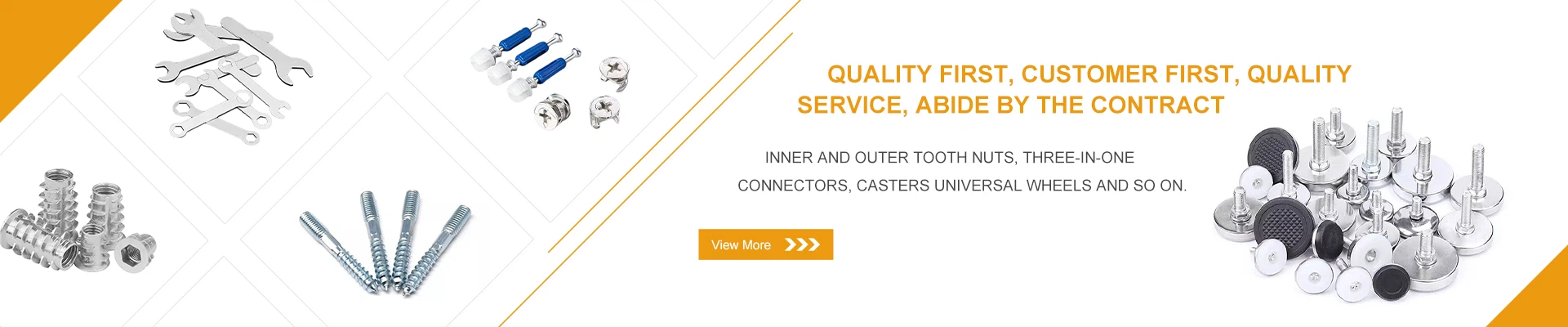
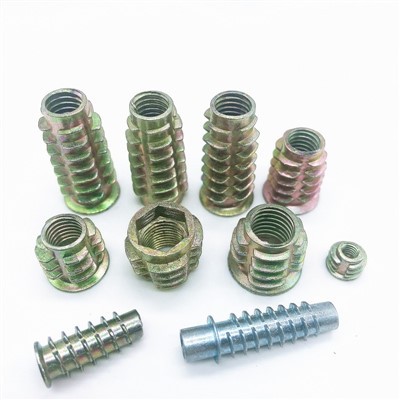
A: These zinc alloy nuts are used to install in wood and plastic providing a female thread with superior holding power. They come in a “Male Thread Style” with a male thread on the outside of the body to thread into the component and a “Knock In Style” with barbs on the outside of the body to be knocked into the component. The male thread style provides a female hex drive to install (screw) the nut into the component. The tapered male thread design and memory grooves provide positive locking resistance against pull out due to torsion or vibration. The Knock In Style barbs hold in firmly without having to “screw in” to the component. In most applications these parts provide superior performance over Propel and T–Nuts but typically require more labor to install and are typically more expensive. They are used to assemble knocked down furniture. This family of inserts is available with flange and without flange in various lengths. Available female thread sizes are 6-32, 8-32, 10-24, 10-32, 1/4-20, 5/16-18, 3/8-16, M4, M5, M6, M8 and M10.
A: A barrel nut (also referred to as cross dowel nuts, dowel nuts, or furniture nuts) is a particular type of fastener designed to coincide with strong bolts and used to join pieces that carry heavy loads. They provide exceptionally strong joints and are commonly used in the aerospace industry in applications from landing gear to wings. They are also used in conjunction with furniture connector bolts in ready-to-assemble furniture that requires the joining of two pieces of wood, delivering a solid connection between wooden panels or beams. You might, for example, see barrel nuts positioned in bed frames. In terms of design, the barrel nut is typically cylindrically shaped with a perpendicular threaded hole through the centre. It functions without leaving an exposed nut on one of the sides of the workpiece, making it a good option for creations where details matter and where you might require an aesthetically-pleasing finish, such as in your home furnishings. These fasteners come in a variety of diameters, lengths, threads, and heads to suit the needs of the job.
Q: How do barrel nuts work?
A: The barrel nut has a circular or semi-circular head with threads perpendicular to the nut length. The nut is placed into a hole inside the material or forging during installation. Then, a standard bolt is threaded into the nut from the outside. The bolt must be appropriate for the barrel nut to allow it to sit in place and remain secure.
Q: What are threaded inserts?
A: Threaded inserts are a clever little invention with a coarse wood screw thread on the outside an a fine machine screw thread on the inside. It effectively allows you to use machine screws in wood and are invaluable for any item where you might want to remove the screw at a later date. With a traditional wood screw, every time you remove the screw it damages the thread it cut in to the wood. Eventually the thread will disappear completely and you’ll no longer be able to use a wood screw in that hole. A better solution is to use threaded machine screws and used in conjunction with threaded inserts this is a relatively simple process.
Q: How to use threaded inserts?
A: Always follow the manufacturer’s recommendations for the pilot hole size. You can use a depth-stop on the drill to help with the drilling depth – this is particularly handy if you have a lot of them to fit.
Fitting the screw in the hole can be tricky. Some have an in-built hex socket. So have a slot designed for flat blade screwdrivers. An easier solution is to use the machine screw you plan to use in the final fitting and attach a locking nut to prevent it from turning. You can then use an impact driver to fully drive the insert nut home. Loosen the locking nut with a small spanner and you can then remove your machine screw. This is also the method you can use on unheaded threaded inserts.
I prefer to use carbon steel insert nuts are they’re robust and very unlikely to break. Obviously if the fitting will be subject to any dampness make sure you use corrosion resistant nuts. You can get brass insert nuts but generally these are only suitable for very soft materials otherwise there’s a reasonable chance they will break on insertion.
A: A nut is a type of fastener with a threaded hole. Nuts are almost always used in conjunction with a mating bolt to fasten multiple parts together. The two partners are kept together by a combination of their threads' friction (with slight elastic deformation), a slight stretching of the bolt, and compression of the parts to be held together.
In applications where vibration or rotation may work a nut loose, various locking mechanisms may be employed: lock washers, jam nuts, eccentric double nuts, specialist adhesive thread-locking fluid such as Loctite, safety pins (split pins) or lockwire in conjunction with castellated nuts, nylon inserts (nyloc nut), or slightly oval-shaped threads.
Square nuts, as well as bolt heads, were the first shape made and used to be the most common largely because they were much easier to manufacture, especially by hand. While rare today due to the reasons stated below for the preference of hexagonal nuts, they are occasionally used in some situations when a maximum amount of torque and grip is needed for a given size: the greater length of each side allows a spanner to be applied with a larger surface area and more leverage at the nut.
The most common shape today is hexagonal, for similar reasons as the bolt head: six sides give a good granularity of angles for a tool to approach from (good in tight spots), but more (and smaller) corners would be vulnerable to being rounded off. It takes only one sixth of a rotation to obtain the next side of the hexagon and grip is optimal. However, polygons with more than six sides do not give the requisite grip and polygons with fewer than six sides take more time to be given a complete rotation. Other specialized shapes exist for certain needs, such as wingnuts for finger adjustment and captive nuts (e.g. cage nuts) for inaccessible areas.
Q: What are nuts, bolts, and screws?
A: The names of nuts, bolts, and screws are often used interchangeably, so it can get quite confusing. They’re all versatile fasteners that securely join objects together, but these are their distinct differences.
Nuts are typically hexagonal, though they come in other shapes as well. They have an internal thread that screws onto a bolt to create tension and hold pieces together.
Bolts, on the other hand, have an external thread. It’s usually secured with a nut on the end or driven into a tapped hole. They’re designed to endure significant tension and shear forces, making them ideal for heavy-duty applications.
Screws, similar to bolts, are also threaded rods. The key difference is that screws are typically driven into an untapped hole. They create their own threads as they’re driven into materials like wood or plastic.
Q: What are the principal types of nuts?
A: Hex Nuts: Hex nuts are the most widely used nut. They feature a six-sided external surface and an internally threaded hole for use with matching bolts and other threaded hardware.
Coupling Nuts: Coupling nuts are extra-long nuts used to join externally threaded components. Two threaded parts such as threaded rods or hanger bolts are screwed into the opposing sides of the coupling nut, providing a strong and easily installed joint between parts.
Jam Nuts: Jam nuts are low-profile, half-height nuts used to prevent the loosening of bolted joints. Jam nuts are installed on a bolt or threaded rod before a full-size nut. They are usually tightened to between 25% and 50% of the joint's desired torque. Then, the full-size nut is installed to the joint's final torque. For many modern applications, lock nuts are preferred to jam nuts.
Lock Nuts: Lock nuts, also known as self-locking nuts, prevailing torque nuts, or nyloc nuts, are similar to standard hex nuts with the addition of a nylon or metal insert. The insert deforms when the nut is installed, increasing the prevailing force required to install the nut and its ability to resist loosening. Self-locking nuts with nylon inserts can be reused many times, although standards in some industries mandate minimum prevailing torque requirements for re-used self-locking nuts, including the Federal Aviation Authority's Acceptable Methods, Techniques, and Practices (AC 43.13-1B).
Q: How do nuts and bolts work?
A: A typical bolt has two main components: a shaft and a head shaped to fit a tool like a wrench. Bolts have an externally threaded shaft. The shaft may be entirely threaded, or it may be divided into threaded and unthreaded portions. The unthreaded portion is often called the shank or the grip length. The most common bolt heads are hex-shaped. However, other variations exist for specialty applications.
A nut is a fastener with an internal thread and an external surface shaped to fit a tool. Like bolt heads, modern nuts are usually hex-shaped. Nuts are screwed onto bolts to form a bolted joint.
The purpose of a bolted joint is to prevent parts from moving relative to each other. Each bolt and nut component plays a role.
The bolt's shaft prevents the parts from moving laterally (sideways) relative to each other.
The bolt's head and the nut prevent parts from moving away from each other.
The clamping force generated by a correctly torqued nut and bolt joint prevents parts from moving radially (rotating relative to each other).
When installing a bolt with a nut, there are two main stages. In the first stage, the nut screws easily onto the bolt until the bolt head and the nut are in contact with the surface of the joined parts.
In the second stage, it becomes much harder to tighten the nut. That's because further tightening—or torquing—elongates the bolt. Like an elastic band, this elongation generates tension in the bolt called the preload force. The preload force creates a clamping force that acts on the joined parts, holding them together.
When installing a nut and bolt, it's essential to achieve the correct preload force. Or, to put it another way, you need to apply the proper amount of torque. Inadequate preload can cause parts to move relative to each other or the nut to unscrew from the bolt. Excessive preload can strip the bolt's threads, causing the joint to fail.
Q: What are the common hexagonal nuts?
A: Finished Hex Nuts: A finished hex nut is the most basic of nuts - the six-sided nut that almost everyone first pictures in their mind when they hear the word “nut” in an industrial context. Hex is short for hexagon, referencing the six sides of the nut. These nuts feature internal threading and are commonly used with machine thread bolts and screws, in applications where no “locking” mechanism is required.
Hex Jam Nuts: Hex jam nuts are low profile - usually only about half as thick as a standard hex nut. Commonly used as a type of lock nut, the jam nut is "jammed" against a standard nut to lock the two in place. Jam nuts are also sometimes used in applications where a traditional, larger profile hex nut would not fit.
Machine Screw Nuts: Designed specifically to be used with machine screws, these hex nuts are much smaller sizes than full-size hex nuts and feature flat tops and chamfered corners. Threads can be coarse (UNC) or fine (UNF), and zinc plating is the most common type of finish applied to machine screw nuts.
Nylon Insert Lock Nuts: Nylon insert lock nuts are very similar to basic finished hex nuts, but feature a nylon insert lock to help secure the nut into place. When a nylon insert lock nut is installed onto a bolt or screw, the nylon insert wraps around the threads, protecting the connection from loosening due to vibration.
Q: What are advantages of square Nuts?
A: Protection from loosening: Square nuts are better protected from loosening than hexagonal nuts. Loosening involves a nut working its way off the bolt to which it’s attached. You can attach hexagonal and square nuts alike by twisting them onto the end of a bolt. Over time, however, some nuts may loosen. But square nuts cover more surface area of the objects with which they are used, so they are better protected from loosening.
Easier to keep track of: You’ll have an easier time keeping track of square nuts than hexagonal nuts. Nuts and other fasteners have a tendency to roll away when dropped. You may accidentally drop a bolt or nut, only to watch it roll away into the abyss where you’re unable to retrieve it. Hexagonal nuts are rounder than square nuts. This semi-round shape allows them to roll away when dropped. Square nuts aren’t round. If you accidentally drop a square nut, it will typically stay in place. This makes square nuts easier to keep track of.
Wrench tightening: You can tighten square nuts using a standard wrench. Hexagonal nuts support wrench tightening as well, but with six sides, you may struggle to grip them with a wrench. Square nuts have fewer but larger sides. As long as you have enough space, you should be able to easily place a wrench around two of these sides so that you tighten the square nut.
Available in a variety of styles: Square nuts are available in a variety of styles. They all feature a square shape consisting of four sides of equal length. With that said, some square nuts feature different characteristics than others. Some square nuts are made of stainless steel, whereas others are made of carbon steel. You can also find square nuts in different sizes, including metric and standard sizes.
Q: What are locking nuts made of?
A: For heavy-duty and industrial applications, all metal lock nuts such as stainless-steel lock nuts, mild steel, zinc, or brass locking nuts are preferred. However, part-nylon or all-plastic lock nuts are also popular in many applications, provided the torque forces they will need to withstand are not too severe.
A: Also known as a butterfly nut, a wing nut is a type of nut that’s characterized by the presence of two tabs. Most types of nuts feature a hexagonal shape. You can install and remove them by turning them. Wing nuts are distinguished from other types of nuts by their use of tabs. As shown in the adjacent photo, they have two tabs. These tabs or “wings” provide gripping surface so that you can easily install and remove them.
A: Wing nuts work like most other nuts: They are designed to hold two or more objects together when used in conjunction with a bolt. You can twist a wing nut onto the end of a bolt to prevent the connected objects from pulling away. Wing nuts feature internal threading, so they can run up and down the bolts with which they are used. The main benefit of wing nuts, however, is their ease of installation and removal. You can install and remove them more easily than other types of nuts thanks to their wings. Traditional nuts have a hexagonal shape, and with six sides, you may have trouble gripping them. Wing nuts offer a more ergonomic design by providing tabs. Rather than gripping the base of a wing nut, you can grip its two tabs.
Q: What are the different types of fasteners?
A: Fasteners are hardware devices used to mechanically join or secure two or more objects together. There are numerous types of fasteners, including screws, bolts, nuts, washers, rivets, pins, clips, and anchors, among others.
Q: What are the 3 types of mechanical fasteners?
A: The three primary types of mechanical fasteners are screws, bolts, and rivets. Each type has its own unique design and purpose. Screws are threaded fasteners that typically require a complementary nut or pre-tapped hole. Bolts are similar to screws but are usually larger and feature a separate nut to secure the joint. Rivets are permanent fasteners that are inserted through aligned holes and secured by deforming or "riveting" the end.
Q: What is the strongest type of fastener?
A: The strength of a fastener depends on various factors such as material, design, and application. However, in general, high-strength bolts, such as grade 8 bolts, are considered to be among the strongest fasteners. These bolts are made from alloy steel and have a high tensile strength.
Q: What form of fasteners is the most commonly used?
A: Screws are one of the most commonly used forms of fasteners. They are versatile, easy to use, and available in a wide range of sizes and designs. Screws are used in various applications, including woodworking, construction, electronics, and household projects.
Q: What are some types of permanent fasteners?
A: Some types of permanent fasteners include rivets, welding, and adhesive bonding. Rivets are cylindrical fasteners that are inserted through aligned holes and secured by deforming the other end. Welding involves melting and fusing two pieces of metal together to create a strong and permanent connection. Adhesive bonding refers to using adhesives or glues to bond surfaces together, creating a durable and permanent bond.
Q: What is the difference between hex nut and insert nut?
A: Not all nuts feature a traditional hexagonal shape. While hexagonal nuts are popular because they are easier to turn — and therefore install — than other shapes, but that doesn't mean all nuts are hexagonal. Insert nuts, for example, feature a cylindrical shape with exterior threading.