Wood Insert Nut

Wood Insert Nut

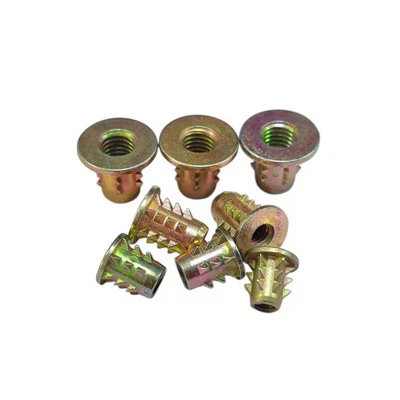
An insert nut provides a threaded socket for a wooden workpiece, similar to a wall anchor. Insert nuts are inserted into a pre-drilled hole by one of two means: screw in and hammer in. In both cases, the external protrusions bite into the wood, preventing the nut from either turning or pulling out. They are threaded internally and externally, the former provides stability for the bolt and the latter provides grip to the object. This also allows the bolt to be easily replaced. Insert nuts are advantageous over barrel nuts and T-nuts, because they can be installed from one side of the workpiece.
Send Inquiry
Product Introduction
Haodeli: Leading Wood Insert Nut Manufacturer in China!

Shenzhen Haodeli Furniture Fittings Co., Ltd. (referred to as "Haodeli Hardware Fittings Factory") is a manufacturer specializing in the production and sales of furniture hardware accessories and furniture plastic accessories manufacturers. The main products are: inner and outer tooth nuts, three-in-one connectors, casters universal wheels and so on.

Wide Product Range

We can export various custom fasteners with a wide variety of plating, which includes different colors of Zinc, Black Oxide, Black Anodizing, Tin, Silver, Waxing, Passivation, Nickel, Antique Brass, Chrome, Cadmium, GM Spec, Magni Coating, Chrysler spec, and so on.

Quality Raw Materials

We supply both inch and metric fasteners. Our fastener line includes a wide range of materials such as steel, stainless steel, brass, silicon bronze, Hastelloy, Inconel, Monel, aluminum, alloy 20, 17-4PH, 17-7PH, titanium, and other non-ferrous metals.

Quality Guaranteed

From quality testing of raw materials to the careful management of manufacturing processes and the comprehensive testing of finished products, we can deliver customer orders that live up to and exceed expectations.


Advanced Equipment

With state-of-the-art Japanese technology power coating lines and professional fabrication machines such as automatic welding and tube laser cutting machines, customers can be assured that every product will be fabricated with precision and care.


Introduction of Wood Insert Nut


An insert nut provides a threaded socket for a wooden workpiece, similar to a wall anchor. Insert nuts are inserted into a pre-drilled hole by one of two means: screw in and hammer in. In both cases, the external protrusions bite into the wood, preventing the nut from either turning or pulling out. They are threaded internally and externally, the former provides stability for the bolt and the latter provides grip to the object. This also allows the bolt to be easily replaced. Insert nuts are advantageous over barrel nuts and T-nuts, because they can be installed from one side of the workpiece.


Our Related Products


M8 Wood Insert

M8 Wood Insert

Wooden threaded inserts are an excellent solution for anyone looking to increase the stability and durability of their connections.
1 2 Threaded Inserts for Wood

1 2 Threaded Inserts for Wood

Wood thread inserts are a versatile and practical device that effectively joins wood pieces. They are ideal for adding strength and stability to furniture joints, attaching knobs or handles, installing hinges, and many other applications.

Furniture Threaded Inserts

Furniture Threaded Inserts

Another advantage of wood threaded inserts is that they are relatively easy to install, even for those who are not good at woodworking.

Brass Threaded Inserts for Wood

Brass Threaded Inserts for Wood

Threaded inserts are very important for people who often work on wood. This is very useful for people who repair furniture as it eases their work load to a great extent.

M6 Wood Insert

M6 Wood Insert

Wood thread inserts are a versatile and reliable way to join wood materials. Used in furniture, cabinets and even construction, these inserts provide a strong, durable connection that will last for years.

Threaded Inserts for Wood Bunnings

Threaded Inserts for Wood Bunnings

Wood thread inserts are an important part of many woodworking projects. Their strength, durability and versatility make them ideal for a variety of different applications, from furniture manufacturing to outdoor projects.

Stainless Steel Threaded Inserts for Wood

Stainless Steel Threaded Inserts for Wood

We offer wooden threaded inserts in different styles and materials such as brass, stainless steel and zinc alloy construction which may vary depending on the style.

Threaded Inserts for Wood with Bolts

Threaded Inserts for Wood with Bolts

When it comes to woodworking, one of the important items you are likely to come across is wood thread inserts. These threaded inserts are very useful because they provide a way to add threaded connections to wood projects.

M6 Threaded Inserts for Wood

M6 Threaded Inserts for Wood

They offer a range of benefits, from easy installation to long-lasting durability, making them ideal for a variety of woodworking projects. So whether you're a professional woodworker or just getting started with DIY, consider incorporating wood thread inserts into your projects for reliable and visually appealing results.


How Do You Cooperate With Us?

Provide CAD Files Or 3D Files or Samples
Only through the above information you provided we can know the size, precision, and key features of the product to be controlled, which is the basis for us to accurately evaluate the price of the product.

Get a Quote
Tell us the quantity of products you need, and we will provide you with corresponding ladder prices according to different quantity requirements.

Specify Process, Material, Surface Treatment

If your requirements are consistent with the drawings you provide, it is not necessary to specify.

Order Your Parts

Send your order to us, we will reply to your specific delivery date.

Receiving Your Parts

After the order is completed, we will notify you in time and cooperate with you in logistics operations.


Types of Wood Insert Nuts
 

We are stocking an elaborate range of fasteners and screws used in manufacture of furniture and wood working.
Range : Joint Connector Bolts, JCB Screws, CM Screws, Chipboard Screws, Barrel Nuts, Hanger Bolts, Connecting Screws, Minifix, Wood Dowels, D-Nuts, T-Nuts etc.

D-Nuts
D-Nuts are a self tapping insert for wood, typically used for knock down furniture assemblies, providing a strong and permanent thread for wood and wood based sheet material. These D Insert Nuts provide a strong, permanent thread for wood and wood-based sheet materials. The incorporated flange alleviates splitting and prevents the Insert Nut from being driven in too far.
D are more effective than wood screws. They are less likely to strip, or cause cracks or splits in any type of wood. Parts can be mass-produced with T-nuts, assembled and reassembled for shipping purposes, or package
D-Nuts are a self tapping insert for wood, typically used for knock down furniture assemblies, providing a strong and permanent thread for wood and wood based sheet material. These D Insert Nuts provide a strong, permanent thread for wood and wood-based sheet materials. The incorporated flange alleviates splitting and prevents the Insert Nut from being driven in too far.

T-Nuts
A T-nut, T nut, or tee nut is a type of nut used to fasten a wood, particle or composite materials workpiece, leaving a flush surface.
T-nuts are threaded steel inserts with prongs that insert claws into wood when they are tightened, and often work when wood screws fail. After a T-nut is installed, a common bolt is used to join corresponding parts together.
T-nuts and are more effective than wood screws. They are less likely to strip, or cause cracks or splits in any type of wood. Parts can be mass-produced with T-nuts, assembled and reassembled for shipping purposes, or packaged as a kit. T-nuts resist movement and vibration, and can be tightened at regular intervals.
Because they have prongs, t-nuts grip softer materials, such as particle board, better than wood screws, which tend to strip.
Now available in Stainless Steel also.
Available in Metric and BSW series.

Sleeve Nuts
Sleeve Nuts are used in furniture and architectural applications where a clean finish is desired.
These nuts are available with a CSK head and Socket drive.

Type I Insert Nut
These Type I Insert Nuts have one end capped, offering a more pleasing appearance and finish.
Typical applications include audio equipment, cabinets, chairs, desks, tables and toys.
Also used to bind two or more parallel wooden panels in conjunction with Joint Connector Bolts.


How to Install a Wood Insert Nut?
 

The following four stages are the major ones in the straightforward process of installing nutserts.

Step 1

Thread a insert nut onto the tool's mandrel; some tools load the nutsert for you.

Step 2

Insert the insert nut into the pre-drilled hole and start the swaging process with the tool. The body of the nutsert will compress and swell out to fill the hole as the tool's mandrel pulls up the insert nut.

Step 3

At this point, the insert nut has bulged and formed a lip on the material's blind side, securely fastening onto the material.

Step 4

Reversing the insert nut tool out of it can be done automatically or manually.


Which are Best: Brass or Steel Inserts Nuts?
M8 Threaded Inserts for Wood
Metal Inserts for Wood
Brass Inserts for Wood
M6 Wood Insert

Brass
Brass offers significant advantages over stainless steel, so it is preferred for most industrial and agricultural applications. But there are applications which require stainless steel. For example, brass and stainless steel both resist corrosion, but they react differently to various corrosive agents, so steel may get the nod in some instances.
Here's a closer look at some of brass' advantages:
Well suited for industrial/residential hot- and cold-water systems, including those carrying potable water.
Withstands some marine environments including brackish water and seawater with moderate currents. Brass exposed to the sea develops a protective green patina.
Performs well in cryogenic applications, making it an alternative to 300 Series stainless steel in some environments.
Typically handles exposure to mild alkaline solutions, though strong solutions such as hydroxides and cyanides should be avoided.
Resists corrosion in nonoxidizing acids. Oxidizing acids should be avoided.
Strength is good; overlaps the tensile strength of 12L14 low-carbon steel.
Can be nickel plated to reduce tarnishing and corrosion or to provide a "silver" finish. Nickel finishes can also put a hard-wearing surface on products such as gears, bearings and plumbing fixtures.

Stainless Steel
300 Series and austenitic stainless steels are the most commonly used steel alloys for inserts, though many of the could also be used.
Among stainless steel's advantages:
Certain grades, such as 316, are more durable than brass in more-aggressive marine environments such as fast-moving currents, but this does not apply to all grades. The most common turning stainless, free-machining 303, contains added sulfur that gives it better machinability than other 300 Series stainless steels. Conversely, sulfur significantly decreases corrosion resistance in seawater. Brackish or slow-moving seawater may also increase crevice or pitting corrosion in various grades.
Excellent resistance to petroleum products and many acids (excepting hydrochloric acids); it can be passivated in citric or nitric acid solutions.
It is typically stronger than brass.
Certain grades of austenitic stainless steel such as 302, 304 and 316 are FDA-approved for food contact, and a good choice for food and beverage applications. Free-machining 303 stainless steel, however, is not approved for use in contact with food.
Austenitic stainless steel withstands higher temperatures than brass, but few applications can take advantage of that fact. The plastic component in which the insert is to be placed would likely melt when exposed to such high temperatures. The service temperatures for most plastic assemblies are within the acceptable service temperature for brass.


Common Problem of Wood Insert Nut


Q: What are advantages of barrel nuts?

A: Easy to Install: One of the main advantages of barrel nuts is that they are easy to install. You do not require any special tools or knowledge to screw the nuts into place. You only need a screwdriver to attach them to any surface. This ease of installation makes them a popular choice for DIY projects.
Secure Fastening: Barrel nuts offer a secure fastening that ensures the joint is sturdy and stable. Their unique tread design allows them to grip tightly onto the surface, making it difficult for them to come loose. With barrel nuts, you can be assured that your DIY project will last long.
Wide Range of Sizes: Barrel nuts come in different sizes, allowing for flexibility when working with different materials. Whether you are working with wood, metal, or plastic, you can easily find the appropriate size that will fit your needs.

Q: What are the advantages of rivet nuts?

A: Rivet nuts come in various shapes and configurations so they can be used in a wide variety of applications. Some are round and some are hexagonally shaped, which keeps them from turning in the hole during installation and makes them ideal for use with woods, plastics, and soft materials. Some are made of rubber to create a watertight seal. Whatever type of rivet nut you choose, they all have similar advantages:
They are blind fasteners, so they are reliable, strong, and vibration-resistant. The beauty of blind fasteners is that they can be installed from one side, which is why they are so popular for applications such as automobile and aerospace manufacturing. The design also forms a lasting joint that, unlike those formed by nuts and bolts, cannot work loose even under constant vibration. Rivet nuts are installed to last.
They create a threaded, removable joint in any material. Where blind rivets form a permanent bond, rivet nuts form a solid foundation to screw in bolts or other threaded fasteners. They also can be installed in virtually any material. In hard metals, for example, they provide a permanent threaded nut that will not pull out. They are also ideal for softer materials such as wood, fiberglass, and plastics, which is why they are used to create furniture, boats, and even consumer electronics-any application that requires easy disassembly and reassembly.
They are ideal for mass production and can help lower installation costs. Rivet nuts work well on the assembly line, so they are perfect for factory or assembly line applications, where they can shorten production time and reduce costs.

Q: What are insert nuts?

A: Similar to a wall anchor, an insert nut offers a threaded socket for a wooden object. A pre-drilled hole can insert nuts placed into it using a screw or a hammer. The external protrusions in both situations encroach on the wood and prevent the nut from spinning or drawing out. They have internal and external threading; the former gives the bolt stability while the latter gives the object grip. Additionally, this makes it simple to replace the bolt.

Q: What is a barrel nut used for?

A: A barrel nut is most commonly used in the aerospace industry and furniture making. The specialised nut bolts individual material pieces together and works well with both sheet metal and wood. You will often see barrel nuts in wooden bed frames and other ready-to-assemble furniture.

Q: What are the features of a barrel nut?

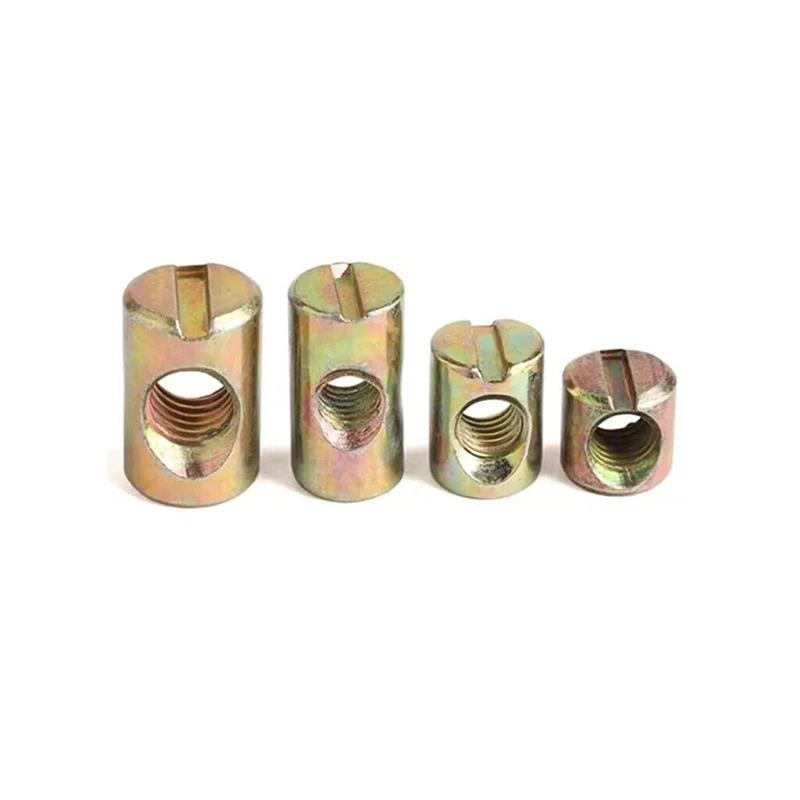
A: Barrel nuts are typically cylindrical or semi-cylindrical in shape. They feature a perpendicular threaded hole through the centre where the appropriate bolt can be driven into the hole and fixed securely in place.

Q: What size are barrel nuts?

A: Barrel nuts range in size. You can find barrel nuts in different lengths, materials, finishes and thread sizes. It's critical to assess the type and size of barrel nuts that you require for your project to enable the best possible results and ensure the sturdiness of furniture and other appliances.

Q: Can threaded inserts for wood be used with different types of wood?

A: Yes, threaded inserts for wood can be used with various types of wood, including hardwoods, softwoods, plywood, and composite materials. The choice of material for the insert, such as brass, stainless steel, or die-cast zinc, ensures that the inserts are suitable for both indoor and outdoor applications and offer resistance to corrosion.

Q: How do i install threaded inserts for wood? Is it a complicated process?

A: Installing threaded inserts for wood is a straightforward process. Simply drill the specified hole size, then thread the insert into place with a bolt and jam nut, hex key, or optional drive tool. Once the insert is installed, it's ready to create a strong connection. The process is quick, easy, and does not require any specialized tools.

Q: What are some common applications of threaded inserts for wood?

A: Threaded inserts for wood have a wide range of applications in woodworking projects. They are commonly used in furniture construction to join pieces such as table legs, chair arms, and cabinet panels. They are also popular in DIY projects, including building workbenches, storage racks, and custom wooden fixtures. Additionally, threaded inserts find use in speaker enclosures, cabinetry, acoustic panels, and reinforcing weak points in wood structures. The versatility and strength of threaded inserts make them an invaluable addition to any woodworking toolkit.

Q: What are threaded inserts?

A: Threaded Inserts are shorthand terminology for threaded screw inserts. To the casual observer of machine designs or mechanical components, the threaded insert is usually completely invisible as they sit within joint holes. However invisible they may be, they are essential to machine design components and are specified to provide critical mechanical joint functionalities. They may even make a screw fastener system possible where it was once impossible.
In short, inserts are internally threaded cylindrical metallic components designed to be placed in tightly fitting holes located within part geometries. These cylindrical inserts fit into holes to provide a functional, threaded interface for use within a fastened joint system. Threaded inserts are typically used where the mating parts consist of a plastic or non-structural metallic base material and may not be able to accept internal threads or mating metallic fasteners. This provides a robust mating thread interface and enables metallic fasteners to be used where they may not be otherwise available.

Q: What are the nuts that go into wood?

A: A T-nut, T nut, or tee nut is a type of nut used to fasten a wood, particle or composite materials workpiece, leaving a flush surface. T-nuts are threaded steel inserts with prongs that insert claws into wood when they are tightened, and often work when wood screws fail.

Q: What is the purpose of a nut?

A: Nuts are almost always used in conjunction with a mating bolt to fasten multiple parts together. The two partners are kept together by a combination of their threads' friction (with slight elastic deformation), a slight stretching of the bolt, and compression of the parts to be held together.

Q: Why are mechanical nuts called nuts?

A: The term "nut" likely derives from the Old English word "hnutu" or the Middle English word "note," which referred to a small, hard fruit with a shell that needed to be cracked open to access the edible part inside. Early fasteners and nuts were often small, hard objects used to secure various components together.

Q: What is screw and nut?

A: Nut, in technology, fastening device consisting of a square or hexagonal block, usually of metal, with a hole in the centre having internal, or female, threads that fit on the male threads of an associated bolt or screw. A bolt or screw with a nut is widely used for fastening machine and structural components.

Q: What are nuts used for tools?

A: Nuts are fasteners with threaded holes that secure to bolts, screws or studs and hold parts together. Once securely fastened, a nut prevents axial movement in connected materials.

Q: What is the purpose of nuts in engineering?

A: Nuts are used in combination with bolts. They are screwed onto the threaded shaft to hold the material between the bolt's head and the shaft in place. They come in varying types compatible with different types of bolts and thread patterns.

Q: Do wood screws need nuts?

A: It may or may not be used with a nut. Wood screws and sheet metal screws make their own threads in the hole, so they are not used with a nut. Machine screws and cap screws, for instance, thread into threaded holes or are used with a nut.

Q: Is there a nut for a wood screw?

A: Wood Threaded Inserts are insert nuts that go into a predrilled hole in wood and has internal threads. Threaded Inserts are best for composite materials, soft wood, plywood and hardwood, you just need to drill a hole that the size of the body into the wood for the threaded insert.

Q: What is a machine nut?

A: A machine nut is used with machine screws to connect materials together mechanically. This type of nut is used with smaller machine screw sizes under 1/4". Hex Machine nuts are used for many fastening applications. Machine screw nuts are often used with hex cap screws, socket screws, and bolts.

Q: What are the advantages of using T nuts?

A: T nuts are a widely used fastening product that provide a number of advantages to applications. They are capable of providing a strong and secure fastening due to their prongs, which grip into the surface they are tightened against. Tee nuts are also quite simple and fast to install. Since they are added to pre-drilled holes, inserting the T nut and tightening them takes little effort and time when compared to other fastening methods. Pronged t nuts are a versatile fastening solution that is effective for use in wood, metal, plastic and composite materials. This makes them suitable for many applications within furniture assembly, the automotive and industrial settings. Stainless steel t nuts offer excellent corrosion resistance and will perform well even in outdoor areas with high humidity and contact with the elements. Finally, T nuts are designed to sit flush with the surface of the material they are applied to. Once tightened they will rest flat against the application, providing a neat and aesthetically pleasing finish.

Hot Tags: wood insert nut, China wood insert nut manufacturers, suppliers, factory, Bed Bolts and Barrel Nuts, Polyurethane Tread Casters, Best Threaded Inserts for Wood, Cap Nuts for Connector Bolts, Furniture Insert Nut, Brass Threaded Inserts for Wood

Send Inquiry

Home

Phone

E-mail

Inquiry