


Helpful hints to start:
Use the links provided to jump start to a specific category in our store
Smart filters are available on each category to help you quickly narrow down to the right size or feature you are looking for
Quick-Guide to Selecting the Right Caster
Below you will a summary that will guide you into the right category and wheel for your mobility needs, along with more detailed explanations for additional learning. Selecting the right caster is not always easy, and we are here to help. Please contact us if you would like support or can't find what you are looking for. We offer thousands of additional solutions and are ready to help out!
Summary to selecting the right caster:
Start by determining the minimum load capacity required per caster: take the maximum loaded weight of your cart/equipment and divide that by (the number of casters you will be using - 1); reasoning explained further below. This typically puts you into three main categories of casters:
Capacities to 350 lbs. per caster – commonly known as 1.25" wide and 1" wide wheel casters (highly utilized casters for shopping carts, store fixtures, moving dollies, workstations, and more)
Capacities from 350 - 1,250 lbs. per caster – commonly known as 2" wide wheel casters (highly utilized for industrial carts, warehouse trucks, and many other carts, racks, and material handling needs)
Capacities over 1,250 lbs. per caster – commonly 2" wide kingpinless casters and 3" wide industrial casters (for heavy material handling and applications exposed to shock and impact)
Review the flooring conditions your equipment will be regularly exposed to determine the best wheel choice (detailed wheel information and pros/cons further described in this post):
Polypropylene for the least expensive mobility: water resistant, lightweight, but noisy and not easy to roll on rough surfaces or over debris
Rubber includes (TPR) for floor protection, vibration dampening, and noise reduction-step up to polyurethane for greater durability
Xtra-Soft Rubber for ultimate floor and cargo protection, debris rejection, best-in-class shock absorption, and quiet mobility
Polyurethane (includes TPU) for floor protection, greater durability, and chemical/oil resistance
Phenolic for high load ratings, durability, and inexpensive mobility
Metal for highest load ratings and shock and impact resistance
Select the size of the wheel: generally speaking, the larger the wheel, the easier it will roll (especially over any debris or thresholds) and the higher capacities you will find. 8" and 6" wheel diameter sizes are commonly used for platform and warehouse trucks because of this reason. 4" and 5" diameters will still handle great capacities and help you lower your overall product height; both are available in 1.25" wide and 2" wide wheels for varying degrees of required capacity. A lighter duty 3" x 1.25" wide caster is also available for lower profile mobility common in store fixtures and smaller equipment.
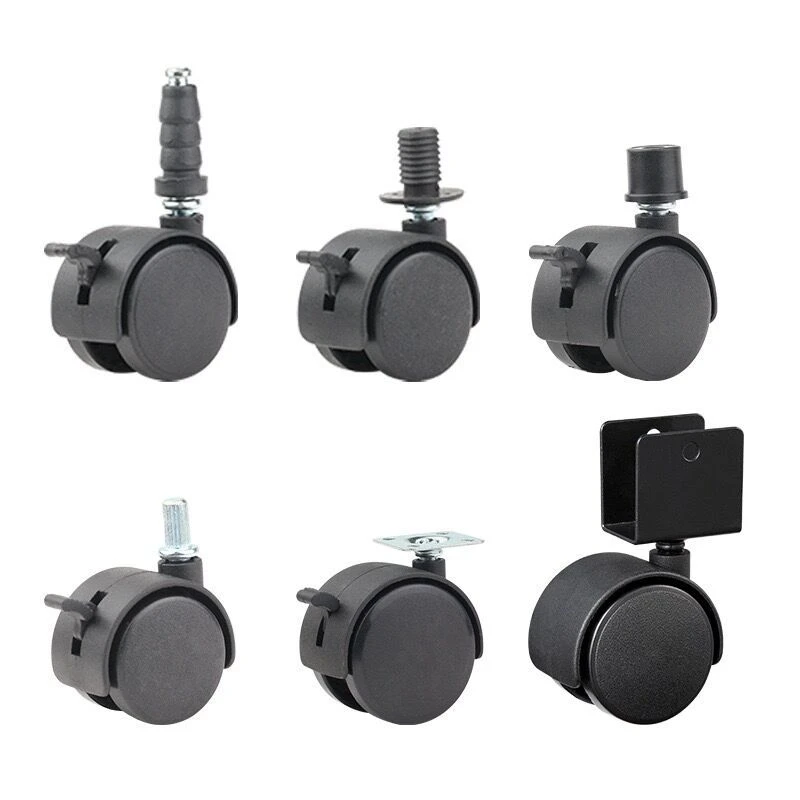
Fastening or mounting choice determines how the caster will mount to your unit. Top plates are the most popular and preferred method due to durability, however you will find many light-to-medium duty applications with stem casters. NextDay Casters currently only offers top plate casters in the most common sizes, however a great variety of stem casters can be found on our sister site CasterSpecialists.com, another division of our company.
Brakes and accessories can be critical to the safety of your users. Selecting the right brake or cart floor lock can keep your products in place when you don't want them moving:
Side locking brakes activate from the side of the caster (on/off lever) and all feature a positive locking brake arm on this site to provide the best brake engagement for you
Top locking brakes activate from the face or top part of the wheel tread, providing secure positive braking directly to the wheel
Top total lock brakes lock both the swivel section of the caster and the wheel, ensuring that the product will not move in any direction regardless of wheel position when braked
Now for the detailed information. We hope that was a short but informative quick crash on the basics of selecting a caster. We will continue to add products and additional information regarding caster types and their purposes over the months to come.
More Information:
Casters are used in a variety of environments, from warehousing to food service, chemical production to schools; and each of these industries use casters on different equipment for different reasons. Given this, caster and wheel selection becomes a process of evaluating the load, the floor, the environment and the use.
Capacity Requirements
First, let's start with the load. Calculating the load requirement is, of all the four areas, the most straightforward. When evaluating the load requirement, take the entire load, including the dead load of the cart, into consideration. Below is a basic formula for calculating caster capacity and beneath it are definitions of the variables.
(Product Load + Cart Weight) / (Number of Casters – 1) = Minimum Required Load Capacity per Caster Required
Conservatively, if four casters are being used, we always divide the total load of the cart by three (3), as opposed to four (4), as it takes only three points to make a plane. It is a very real concern that floors are not level and that one caster will not be in contact with the ground. Using a four wheel formula could cause premature failure of the casters. So let us start with a basic application, say a 2000 lb load, including the cart.
2000 lbs / 3 = 666.67 lbs ~ 675 lbs required per caster
We tend to round up the number to the nearest ten or twenty-five, as it is always better to have a slightly heavier duty caster as opposed to a slightly lesser duty to build in a higher safety factor. Higher capacity can generally be achieved by utilizing a wider tread width or a heavier duty rig or wheel.


